
Publications
New Publication – Comparison of Biofuel Life Cycle Analysis Tools: biochemical 2G ethanol production and distribution
Dec 2020Second-generation (2G) or lignocellulosic biofuels are deemed advanced in view of the several advantages when compared to first generation biofuels. If deployed in large scale, […]
read more
New Publication – Workshop report: Waste-to-Energy fly ash valorisation
Dec 2020Report of a digital workshop held on October 7, 2020. The workshop was organized by representatives of SINTEF (Norway) and RISE (Sweden), within the framework […]
read more
New Publication – Case story: Deep bedding: a co-digestion substrate with significant potential (Denmark)
Nov 2020This case story, developed within the framework of IEA Bioenergy Task 37 (biogas), describes the Danish experience with handling and feeding deep bedding to biogas […]
read more
New Publication – Workshop report: Waste for feedstock recycling – Challenges and opportunities
Nov 2020Report of a digital workshop held on June 15, 2020. The workshop was organized by members of the US Department of Energy (USDOE) and Office […]
read more
New Publication – The Role of Renewable Transport Fuels in Decarbonizing Road Transport
Nov 2020In the light of climate change, there is an urgent need to decarbonize our societies. The road transport sector is specifically challenging, as transport demand […]
read more
New Publication – Case story: Production of food grade sustainable CO2 from a large biogas facility (Denmark)
Nov 2020Biogas typically consists of 60% biomethane which is used as a renewable fuel, while the remaining 40% is a natural residual product in the form […]
read more
New Publication – Sustainability governance of Canada’s agriculture-based bioeconomy
Nov 2020This report, produced in the framework of IEA Bioenergy Task 43 (biomass supply), provides a current Canadian perspective on how the sustainability of the agricultural […]
read more-
ART Fuels Forum and IEA Bioenergy publish success stories of advanced transport biofuels
Nov 2020The EU transport sector is almost entirely dependent on fossil fuel, and the expectation is that this will still be 90% in 2030. The recast […]
read more 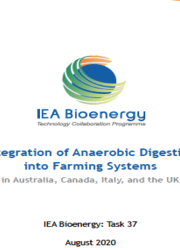
New Publication – Integration of Anaerobic Digestion into Farming Systems (in Australia, Canada, Italy, and the UK)
Nov 2020This report of IEA Bioenergy Task 37 (Energy from biogas) assesses the role of biogas integrated into the farming system through examination of policy, practices […]
read more