Regional integration and collaboration are key to the viability of bioenergy systems
Replacing centralised fossil-fuel systems with decentralised renewable energy supply is a major defining macro-trend of the energy transition, mainly driven by the large deployment of wind energy and photovoltaics systems.
Commoditisation and regionalisation
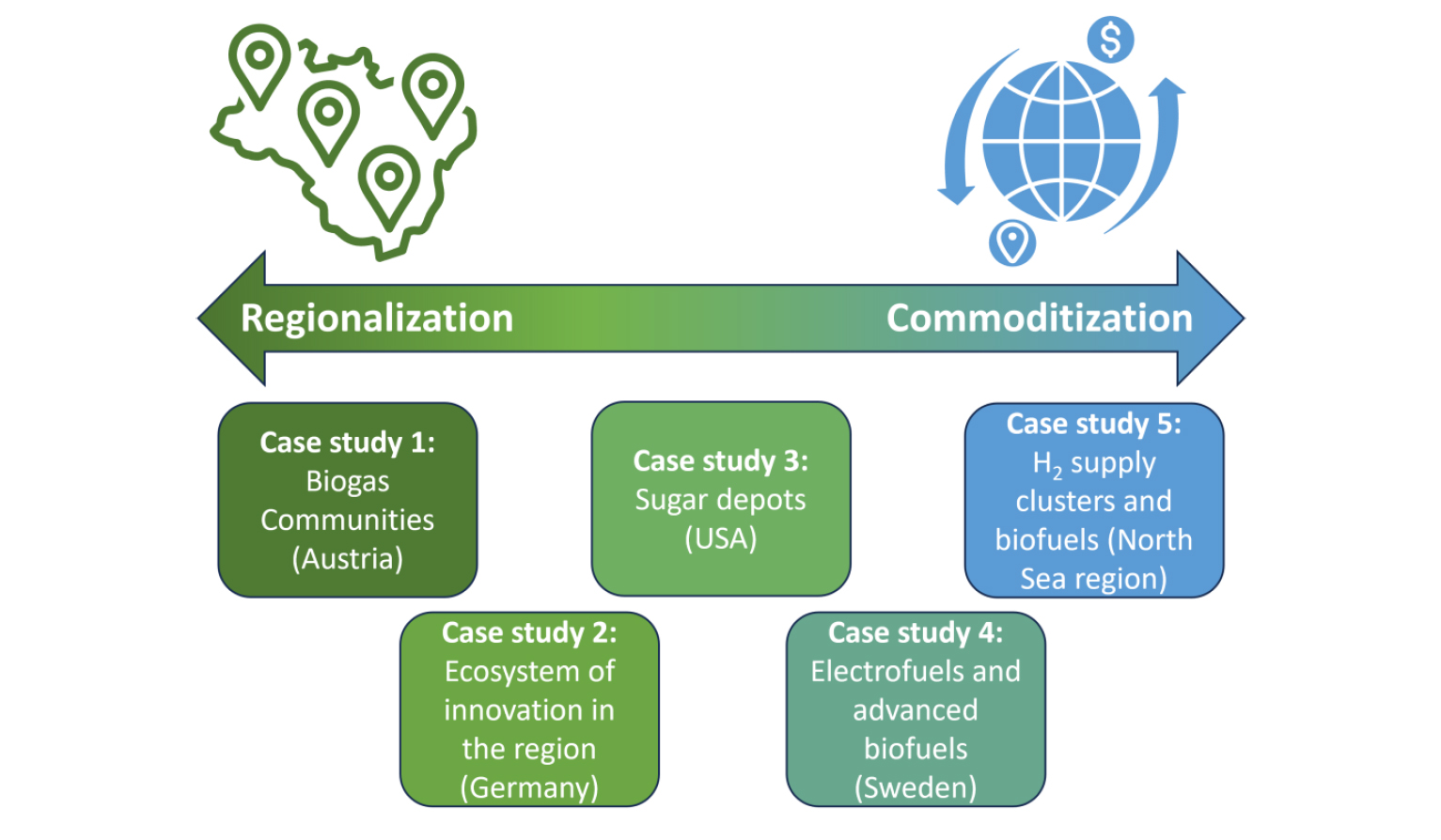
Bioenergy follows a dual trend. While short, regional supply chains offer a path to decentralised systems, increasing commoditisation aims to link diverse biomass sources to global markets. The so-called “Regional Transitions 2.0” project – executed by IEA Bioenergy’ Task 40 (Deployment of biogenic value chains and carbon management) investigated whether regionalisation and commoditisation of bioenergy supply chains are mutually inclusive strategies for sustainable bioenergy. The project also investigated where these different strategies offer clear sustainability advantages.
The Regional Transitions 2.0 project has evaluated case studies on both regionalisation and commoditisation strategies in in five different countries: Austria, Germany, Sweden, USA, and the North Sea region. Both strategies present unique opportunities and risks, whereby in all cases, the regional context is crucial for the sustainability of biobased supply chains.
Country specific approaches
Biogas communities in Austria showcase a highly regionalised approach, using collective management to convert local waste into energy. The BioZ project in Germany leverages regional strengths, such as agriculture and the chemical industry, to create a competitive advantage and foster a bio-based economy. The Sugar Depots in the U.S. add value to the region by creating a standardized, commoditized product for broader markets. The Swedish study on bioelectrofuels and electrofuels evaluates the viability of both centralized and decentralized production models, finding that co-location with existing industries (such as district heating) is vital to economic viability. Lastly, the North Sea region case study represents a highly commoditized value chain, with ports acting as hubs for global trade in biomass and green hydrogen.
Regional integration and collaboration are key to viability of bioenergy systems
All case studies confirm that regional integration and collaboration are key to economic viability. Regionalization offers benefits such as reduced emissions and local economic development, but it can risk isolation from broader markets. Conversely, commoditization provides access to global markets and economies of scale but can lead to economic inequality and a loss of regional identity. The best strategy often involves a hybrid approach of regionalization and commoditization, creating a network of interconnected supply chains that leverage local strengths while remaining integrated into the global market. [link to download of pdf or document]
Key findings for policy makers:
- Regionalisation and commoditisation are mutually inclusive strategies for sustainable biobased value chains.
- Regional integration and collaboration are key to the economic viability of bioenergy systems.
- This can be achieved by creating a network of interconnected supply chains that leverage local strengths while remaining integrated into the global market.