Direct Thermochemical Liquefaction (DTL) Technology Options for Bioenergy Carbon Capture and Storage (BECCS)
The traditional concept of bioenergy with carbon capture and storage (BECCS) is based on biomass combustion for the provision of heat and power, coupled with an integrated capturing of CO2 from the emitted flue gases. In the processing steps from biomass resource to usable bioenergy significant carbon containing waste streams/ byproducts also may emerge, not required for the specific envisaged bioenergy conversion facility. Typical examples are e.g. the direct emission of biogenic CO2, or biogenic solid waste fractions (e.g. distillers dried grains with solubles from ethanol production, seed expeller from oil extraction for the production of HVO, lignin from lignocellulosic fractionation etc.). Some of these carbonaceous byproducts represent high value products to be deployed in other non-energy markets, e.g. as animal feed while others, e.g. CO2, can be readily captured and permanently storage in the underground, thus contributing to Carbon Dioxide Removal (CDR) from the atmosphere.
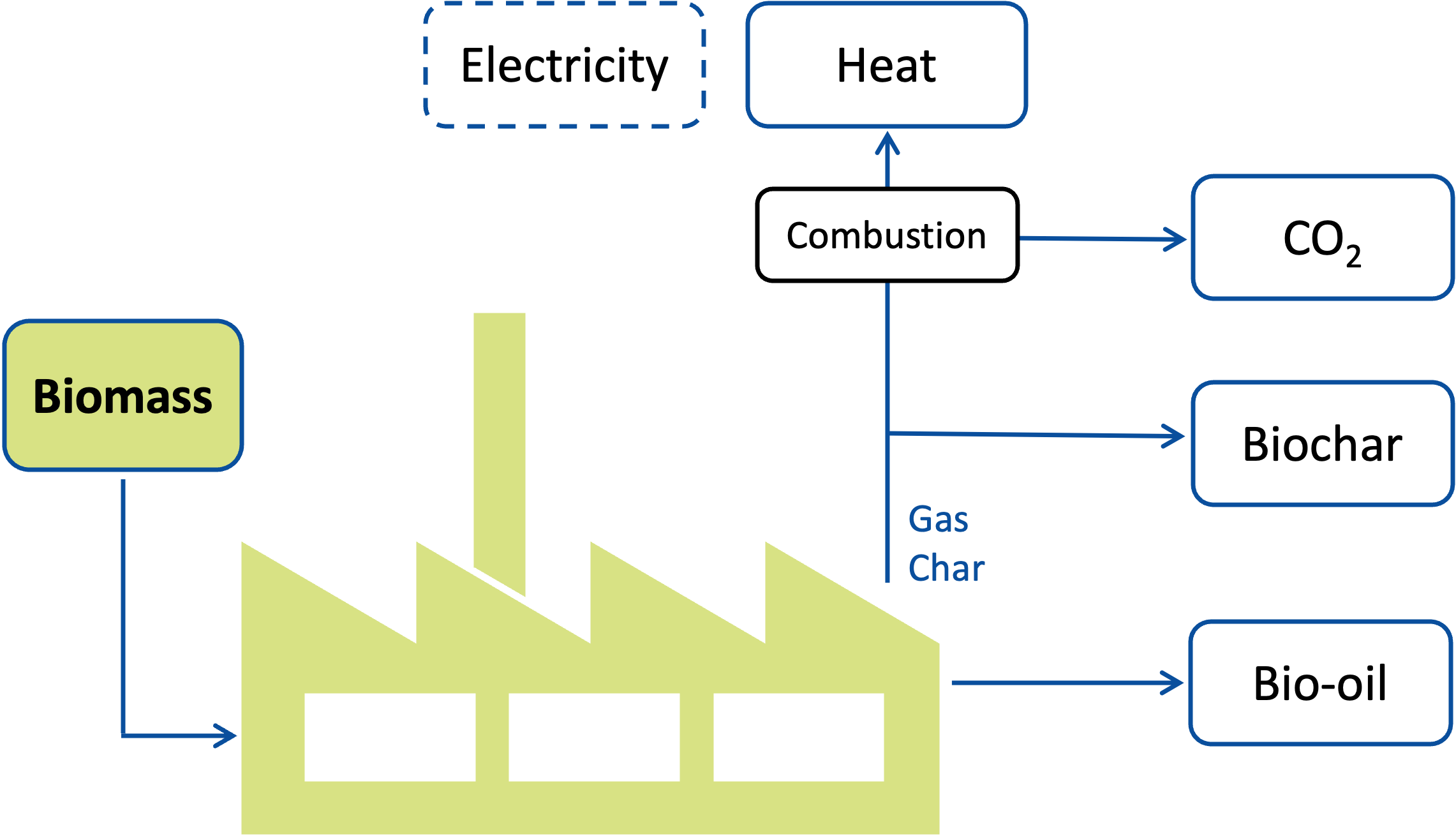
In the Strategic Project’ Bioenergy Carbon Capture, Usage and Storage (BECCUS)’ several expert groups (gathered in so-called Tasks) collaborate to explore the deployment of biogenic value chains and carbon management. The experts of IEA Bioenergy Task 34: Direct Thermochemical Liquefaction explore in this report the technology perspectives of Direct Thermal Liquifaction for bioenergy carbon capture and storage. For the case of direct thermochemical liquefaction as relatively new established commercial process, there are varying possibilities on how to achieve CDR with its products. Fast pyrolysis bio-oil (FPBO) as main product can be directly used as boiler fuel or as biobased commodity to further produce advanced fuels and chemicals. It has been proposed to sequester the bio-oil in geological deposits, which might be beneficial since it exhibits a similar carbon content as the original biomass and is thus higher than that of e.g. CO2. While this gives the impression of replenishing natural oil resources, it is highly likely that the FPBO will further react in the deposits to form solids once thermodynamic equilibrium is achieved over time.
Key findings of the report
- Capturing the CO2 from the flue gases of pyrolysis internal combustion is a readily available option to realize Carbon Dioxide Removal from fast pyrolysis processes
- As an advantage biochar can be separately recovered to enable uses that also realize carbon sequestration
- The use of the solid by-product from Hydro Thermal Liquefaction (HTL), sometimes referred to as hydrochar, is still subject to further research
About the BECCUS project
Within IEA Bioenergy TCP the topic of Bioenergy Carbon Capture, Usage and Storage is investigated with the involvement of many expert Groups (Tasks) – coordinated by Task 40 (Deployment of biogenic value chains and carbon management) – in an integral project of strategic relevance. In the years 2019-2021 the ‘Deployment of BECCUS value chains’-project was executed to understand the opportunities for, and obstacles to, deployment of BECCUs in different sectors. The project focused on determining factors for successful deployment, such as technology readiness levels, business model validities and designs of policy and regulatory framework.
In the second phase, the ‘BECCUS 2’-project is more diverse in scope, with stronger emphasis on cross-sector and cross-country learning about the implementation of BECCUS projects , using different energy conversion processes. The project also explores the effects of integrating BECCUSS facilities and systems within the overall energy system and, last but not least assesses the important differences between utilisation of captured carbon and storage of capture carbon.
Read more about Inter-task project BECCUS Phase 2