Implementation Examples for Organic Waste Valorization Technologies
Organic wastes, such as wastewater sludge, animal manure, and food waste present both a management challenge and an opportunity to recover energy and valuable materials.
While anaerobic digestion (AD) and composting of organise waste are widely deployed, these technologies typically produce a limited set of products and may only be viable where supportive local markets or policy incentives exist. Exploring additional valorization pathways can expand potential products and end markets, enabling solutions better matched to the characteristics of specific waste streams.
IEA Bioenergy Task 36 (Material and Energy Valorization of Waste in a Circular Economy) therefore compiled a report of use cases showing different technological pathways (anaerobic digestion with carbon capture and utilization/sequestration, hydrothermal carbonization, hydrothermal liquefaction, etc.) for organic waste valorization for local solutions. The selected projects pair a reliable wet waste feedstock with a clear, local outlet for products and straightforward site integration.
Download the full document “Implementation Examples for Organic Waste Valorization Technologies”
Technologies covered in this report include anaerobic digestion with carbon capture and utilization/storage (CCU/CCS), hydrothermal carbonization (HTC), hydrothermal liquefaction (HTL), pyrolysis to biochar, and hydrogen production via proton exchange membrane (PEM) electrolysis. Each use case highlights technical specifications, years of operation, business arrangements, and practical factors that support project delivery.
Conclusions
The report concludes that there is no single “best” technology pathway for organic waste valorization. Project scale, ownership structure, and financing mechanisms vary substantially across cases, reflecting the range of local contexts in which these technologies can be deployed. Communities, utilities, and project developers can draw on these use cases to understand options, constraints, and transferable practices to help evaluate which combination of technology, market, and business model fits local goals, infrastructure, and financing capacity. Where supportive policy is available and funding is aligned, projects may be better positioned to proceed
Some key findings for policy makers:
- Across the profiled waste-valorization projects, several common factors contribute to successful implementation which tend to pair a reliable wet waste feedstock with a clear, local outlet for products and straightforward site integration. Co-locating conversion or Carbon Capture and Utilization units next to the waste stream or CO2 source may lower logistics costs and risk.
- Other observed patterns include the use of separate but coordinated operators, sequential commissioning of base assets before adding processing lines, attention to product quality to ensure market value, and practical site integration measures such as compact footprints.
- Policy context plays an important role in project viability. Several Anaerobic Digestion with Carbon Capture and Utilization projects have benefited from biomethane support schemes, such as Denmark’s 20-year grid injection price premium and the UK’s Non-Domestic Renewable Heat Incentive.
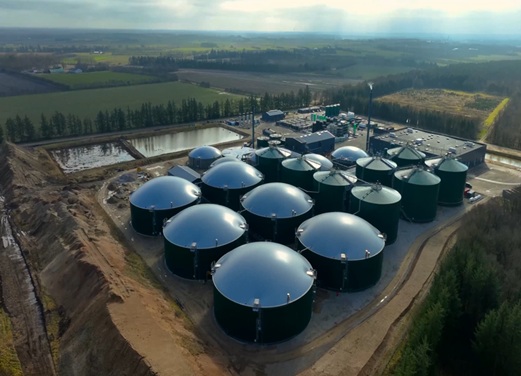
- Financing models vary considerably, from private equity with multilateral loans (see th Tønder Biogas case), to public concession contracts (see the Pau-Lescar case), to private service contracts in which a technology provider builds, operates, and maintains the facility for a host utility (see the Silicon Valley Clean Water case).
Read more on organic waste valorization:
- Advanced and smart sorting and monitoring technologies for food waste – Swedish case study & emerging digital solutions
- Advanced sorting technologies – Focus: Food Waste
- Synergies of green hydrogen and biobased value chains deployment